Sunday, April 14, 2013

Drying agent


Drying agent is a chemical that usually used in absorbing the water present in the organic solvent. This is because the presence of water may cause the ineffective reaction or any other undesirable reactions.

The efficiency of drying agent is measured by capacity and rate. The maximum number of moles of water that the drying agent can absorb is called capacity. The rate of water absorption is another factor that affects the efficiency of drying agent. Some of the examples of drying agents are shown in below.


Magnesium Sulfate:

Advantage: Magnesium sulfate is a rapid and efficient drying agent with high capacity.

Disadvantage: Sensitive to epoxide, need to be filtered out due to its fine powder form


Sodium Sulfate:

Advantage: less reactive, present in granule form which is easier to be removed, high capacity  

Disadvantage: lower efficiency and lower completeness than magnesium sulfate


Calcium Sulfate:

Advantage: High completeness, high efficiency

Disadvantage: low capacity


Calcium Chloride:

Advantage: High completeness, high efficiency

Disadvantage: low capacity


Potassium Carbonate:

Advantage: moderate capacity, moderate efficiency

Disadvantage: Not sure


Tuesday, April 2, 2013

Polymer solubility parameter and solubility of polymer

Questions:

1. Calculate the polymer solubility parameter, δ2 for PVC, LDPE, PS and PMMA by using the equation below, where the molar attraction constant per unit for the functional groups are referring to the appendix 1.


clip_image002


Type of polymers and their repeating unit

Molecular weight, M

(g mol-1)

Sum of molar attraction constant, ∑E

(J1/2 cm3/2 mol-1)

Density, ρ (g cm-3)

Solubility parameters, δ2 (J1/2 cm-3/2)

-(CH2CHCl)-

Poly(vinyl chloride)

62.50

891.00

1.41

20.10

-(CH2CH2)-

Low Density Polyethylene

28.00

560.00

0.85

17.00

-CH2CHΦ)-

Polystyrene

104.00

1937.00

1.05

19.56

-[CH2CH(COOCH3)]-

Poly(methyl methacrylate)

86.00

1352.00

1.17

18.39


2. Explain how solubility is affected by polymer chain structure.

When molecular weight of polymer increases, its solubility will decrease. Crosslinked polymers do not dissolve but they only swell when the solvent diffuse into the polymers. Lightly crosslinked polymers swell extensively in solvent in which unvulcanized material would dissolve. When crosslinking degree increases, the solubility decreases. This is because the strong cross-linked polymers will inhibit interaction polymer chains and solvent molecules.


Tuesday, March 19, 2013

Synthesis of poly(methyl methacrylate) or poly(methyl methacrylate)-co-poly(butyl acrylate) & characterization of the polymers by infrared spectroscopy (IR)

Objectives:

1. To synthesize poly(methyl methacrylate) and poly(methyl methacrylate)-co-poly(butyl acrylate)

2. To characterize poly(methyl methacrylate) and poly(methyl methacrylate)-co-poly(butyl acrylate) by using infrared spectroscopy (IR) and differential scanning calorimetry (DSC)

Introduction:

Poly(methyl methacrylate), PMMA, is known as Plexiglas in 20th century, is an amorphous, transparent and colourless thermoplastic. PMMA is hard and stiff but brittle and notch-sensitive, with a glass transition temperature of 105°C. PMMA is a polymer that made up from its basic unit of methyl methacrylate, MMA. Figure 1 show the monomer MMA and its polymer.

image

Figure 1 PMMA and its monomer unit

PMMA is a polymer that has characteristics of good abrasion and UV resistance and excellent optical clarity but poor low temperature, fatigue and solvent resistance. Besides, it is flammable but has low smoke emission.

PMMA usually behaves in a brittle manner when loaded, thus restricting its application. The solution to overcome is copolymerizes of MMA with other monomers, such as butyl acrylate (BA). Brandrup J. & Immergut E.H.’s study (as cited in Sirapanichart, S., Monvisade P., Siriphannon P., & Nukeaw J., 2011) found that poly(butyl acrylate), PBA is considered as a colourless transparent rubbery polymer at ambient temperature, thus it is commonly used in copolymer systems to alleviate the brittleness of the final product.

PMMA is produced through free radical polymerization from MMA. In this experiment, PMMA is synthesized via bulk polymerization by using free radical that produced by redox initiator. MMA is supplied with a small amount of inhibitors (an organic acid), which is used to prevent polymerization during shipping and storage. By using excess initiator, MMA still can be polymerized in the presence of inhibitors but low yield will be produced. To maximize the yield of polymer, the inhibitors are usually removed prior to use in order to generate long chain polymer at fast rate. The inhibitor can be removed through the process of distillation, chromatography or base extraction. For the copolymerization between MMA and BA, the synthesis is following the same method as polymerization of pure MMA. The figure 2 below shows the possible polymerization between BA and MMA monomers.

image 

Figure 2 Polymerization between BA and MMA monomers.

Apparatus:

Pasteur pipette, large test tube, beaker, heater, Buchner funnel, watch glass, boiling tube

Materials:

Methyl methacylate (MMA), butyl acrylate (BA), N,N-dimethylaniline, benzoyl peroxide, boiling chip, methanol, acetone, alumina, 10% sodium hydroxide solution

Instruments:

Infrared spectrophotometer, differentiate scanning calorimeter

Procedures:

Removal of inhibitor by extraction

1. MMA and BA were purified by extraction with 10% sodium hydroxide solution.

Polymerization of monomers

1. 10ml of MMA was added with 1 drop of N,N-dimethylaniline and 0.1g benzoyl peroxide. The mixture was placed in boiling water bath.

2. At 3 minutes interval, 1 drop of aliquot was transferred into a test tube with methanol. Observation was recorded.

3. After 15 minutes, boiling tube was cooled and polymer was dissolved in 10-15ml of acetone.

4. While stirring vigorously, the polymer solution was poured into a beaker containing 80-100ml methanol.

5. Precipitated polymer was collected by vacuum filtration. The percent conversion was determined.

6. Steps 1-5 were repeated by using 65:35 of MMA: BA.

Characterization of polymers

1. 20% w/v solution of PMMA in acetone was prepared and was casted on a glass plate.

2. Clear film was obtained for IR and TGA analysis.

3. Procedures were repeated by using mixture of MMA and BA.

Results and calculation:

Part 1

Table 1.1: Observation of PMMA in methanol

Observations

3rd minute

Aliquots turns solution to cloudy.

6th minute

White precipitate is formed at the bottom and clear solution.

9th minute

White precipitate is formed at the bottom and clear solution.

12th minute

White precipitate is formed at the bottom and clear solution.

15th minute

White precipitate is formed at the bottom and clear solution.

Table 1.2: Weight of PMMA synthesized

Weight of empty petri dish

52.75g

Weight of (petri dish + poly(methyl methacrylate) PMMA)

55.36g

Weight of poly(methyl methacrylate) PMMA

2.61g

Table 1.3: Significant peaks of PMMA in IR spectrum (Appendix I)

Functional groups

Wavenumber, v (cm-1)

C=O stretch

1727

C-O stretch

1152

Part 2

Table 2.1: Observation of co-poly(MMA/BA) in methanol

Observations

3rd minute

Small amount of white precipitate is formed and clear solution.

6th minute

More white precipitate is formed and clear solution.

9th minute

Larger amount of white precipitate is formed and clear solution.

12th minute

More and more white precipitate is formed and clear solution.

15th minute

Largest amount of white precipitate is formed and clear solution.


Wednesday, March 6, 2013

Resonance structure of acetylacetonate, magnetic moment of Mn(acac)3

Questions:

1. Draw the structures of acetylacetonate and its resonance structure.

image


2. Structure of Mn(acac)3

image


3. Find out the magnetic moment of Mn(acac)3.

Charge of Mn3+ = +3

Total number of electron in Mn atom = 25

Number of electron in Mn3+ ion = 22

Eletron configuration of Mn3+ : [Ar] 3d4

μs = g √s(s+1)

= 2 √ 2(2+1)

= 4.90μB


Tuesday, February 19, 2013

Preparation of cis-bis(glycinato)copper(II) monohydrate & tran-bis(glycinato)copper(II) monohydrate

Objectives:

1. To prepare both cis- and trans­ copper glycine complexes

2. To verify the complex is kinetic product or thermodynamic product

3. To characterize both cis- and trans­ copper glycine complexes

Introduction:

Glycine is one of the biologically important compounds in the group of amino acids. Among the twenty one natural amino acids, glycine is the simplest amino aicd. Amino acid has both the functional group of amine (-NH2) and carboxylic acid (-COOH). They are the basic units of the proteins in which the building block of every single living cell. Proteins are polypeptides or polyamide that formed by joining the –NH2 group of one amino acid to the –COOH group of another one and therefore a long and complicated peptide chain is formed.


Glycine is the simplest model for peptide coordination and its complexes with various metal ions have been thoroughly studied. Elzbieta (2008) claimed that glycine can even forms more essentially stable complex with copper (II) compared to other amino acids. The structure and stability of the complexes are determined by nature of metal, the nature of the ligands and environment. The environment is controlled by the factors such as temperature, the type of solvent, the interaction enthalpies, entropies, and Gibbs energies.


The binding modes of glycine ligand can be varied since it has at least two donor atoms. The glycinate ion is able to adopt a η3-coordinated mode via its amino, -NH2 and carboxylate, -COOH groups to chelate one copper ion and bridge to another copper ion. The variation of glycinate binding modes is shown in the picture below:

image

Picture 2. Five coordination modes of amino acid. a) η1-coordination mode; b)η2-coordination mode; c) η3-coordination mode with strong Cu-O bond; d)η3-coordination mode with weak Cu-O bond beyond 2.5 Å; e)η4-coordination mode (M is Na+ ion or lanthanide ion)


In this experiment, a pair of geometric isomers of copper(II) glycine complex are prepared. Deprotonated glycine, or known as glycinate ion, NH2CH2COO- is capable to form two coordination bonds to copper metal through the lone pair electrons of nitrogen and oxygen atoms. Hence, it functions as a chelating ligand or more specifically it is known as bidentate ligand and favors the formation of bis(glycinato)copper(II) complex. The reaction between copper(II) acetate monohydrate and glycine can produces mixture of both isomers in an equilibrium mixture. However, the cis isomer precipitates much more quickly then trans isomer and hence leading to a shift in equilibrium away from trans with producing only cis isomer. Cis isomer is the kinectically favoured product whereas trans isomer is thermodynamically favoured. In order to produce trans isomer, the cis isomer can be converted into another isomer by supplying heat energy at 180 °C for time of 15 minutes.

image

Picture 3. a) cis-Cu(gly)2 b) trans-Cu(gly)2

Materials:

Copper(II) acetate monohydrate, glycine, ethanol 95%

Apparatus:

Magnetic stirring hot plate, magnetic stirring bar, Erlenmeyer flask, Hirsch funnel, test tube

Procedure:

Part A: Preparation of cis-bis(glycinato)copper(II) monohydrate

image

Part B: Preparation of tran-bis(glycinato)copper(II)

image

Results and calculations:

Table 1 Amount of reactants used and amount of products obtained

Reactants

Weight of copper(II) acetate monohydrate

0.3007g

Weight of glycine

0.2328g

Products

Weight of filter paper I

0.3233g

Weight of filter paper I + cis-product

0.6061g

Weight of cis-product

0.2828g

Weight of filter paper II

0.3001g

Weight of filter paper II + trans-product

0.3684g

Weight of trans-product

0.0683g

Chemical reaction:

(CH3COO)2Cu.H2O + 2 H2NCH2COOH àcis-(H2NCH2COO)2Cu.H2O + 2 CH3COOH

Determination of limiting agent

Molecular weight of (CH3COO)2Cu.H2O = 199.55 g mol-1

Number of mole of (CH3COO)2Cu.H2O = 0.3007g / 199.55 g mol-1

= 0.0015 mol

Molecular weight of H2NCH2COOH = 75.00 g mol-1

Number of mole of H2NCH2COOH = 0.2328g / 75.00 g mol-1

= 0.0031 mol

Thus, copper(II) acetate monohydrate is the limiting agent in this reaction.

Percentage yield calculation

Molecular weight of (H2NCH2COO)2Cu.H2O = 229.55 g mol-1

Theoretical weight of cis-(H2NCH2COO)2Cu.H2O = 0.0015 mol x 229.55 g mol-1

= 0.3443 g

Percentage yield of cis-(H2NCH2COO)2Cu.H2O = 0.2828g / 0.3443g x 100%

= 82.14%

Theoretical weight of trans-(H2NCH2COO)2Cu. = 70 mg

Percentage yield of tran-(H2NCH2COO)2Cu = 0.0683g / 0.070 g x 100%

= 97.57%

Discussion:

From this experiment, the weights of both isomer cis-Cu(gly)2.H2O and trans-Cu(gly)2 obtained are 0.3443g and 0.0683g respectively. Each isomer contributed the percentage yield of 82.14% for cis-Cu(gly)2.H2O and 97.57% for trans-Cu(gly)2 respectively.


The dissociation of glycine molecule produces a glycinate anion, NH2CH2COO- in which it replaces the position of acetate ion, CH3COO- in the copper complex. The dissociated proton from glycintate ion is accepted by acetate ion and hence acetic acid is produced in the reaction between copper(II) acetate monohydrate and glycine.

(CH3COO)2Cu.H2O + 2 H2NCH2COOH à(H2NCH2COO)2Cu.H2O + 2 CH3COOH

The reaction was takes place in a hot 95% ethanol. Ethanol did not participate in the reaction but it acts as a medium to allow the copper(II) complex to form at 70°C. When cooled down, the copper(II) complex crystallize out from the ethanol.

The solid cis-monohydrate was heated at 200 °C by using an aluminium block in order to convert cis-monohydrate to trans­-complex. The temperature of aluminium block is approximately measured by using hexane with a thermometer. The dehydration of cis-bis(glycinato) copper(II) monohydrate, cis-Cu(gly)2.H2O at sufficiently high temperature (approximately at 200 °C)leads to the formation of mainly anhydrous trans-complex, which is readily to be re-hydrated to give trans-bis(glycinato) copper(II), trans-Cu(gly)2.H2O if present in solution.

Precaution steps:

1. Handle copper(II) acetate monohydrate carefully. It is harmful if swallowed, inhaled or absorbed through the skin.

2. Keep a distance from the hot plate when heating aluminium block.


Friday, February 1, 2013

Reduction of 1-phenyl-1,2-propanedione to 1-phenyl-1,2-propanediol

Asymmetric Synthesis with Baker’s Yeast:

Objectives:

1. To reduce 1-phenyl-1,2-propanedione to 1-phenyl-1,2-propanediol

2. To monitor the course of reaction by using TLC

3. To characterize the produce by FT-IR spectroscopy and gas chromatography-mass spectroscopy (GC-MS)

Introduction:

Lithium aluminium hydride and sodium borohydride are good reducing agent, in which it can reduce a ketone to an alcohol. However, they are not able to generate a chiral alcohol because they can nucleophilic attack both sides of carbonyl group, hence producing racemic mixture. In order to obtain a chiral alcohol, baker’s yeast is used.

Asymmetric reduction of 1-phenyl-1,2-propanedione by using baker’s yeast in this experiment in order to produce (-)-(1R,2S)-1-phenyl-1,2-propanediol with the enantiomeric excess of 98% or more. The completeness of reaction is determined by using thin layer chromatography (TLC). Pure 1-phenyl-1,2-propanediol is characterized by using infrared (IR) spectroscopy and mass gas chromatography-mass spectroscopy (GC-MS).

Apparatus:

Erlenmeyer flask, hotplate-stirrer, magnetic stirring bar, TLC tank, micropipette, separatory funnel, UV lamp, rotary evaporator

Materials:

1-phenyl-1,2-propanedione, freeze-dried Baker’s yeast, TLC plate, tert­-butyl methyl ether (BME), magnesium sulphate anhydrous, cylohexane

Instruments:

IR spectroscopy, gas chromatography-mass spectrometer

Procedures:

clip_image002

Result and calculations:
Observations on TLC plate:

clip_image004

Descriptions:
At 0th minute, two spots present on the TLC plate. Reactant and product present in the reaction mixture.

At 20th minute, two spots present on the TLC plate. Reactant and product present in the reaction mixture.

At 40th minute, only one spot presents on the TLC plate. Reactants have been used up shows complete reaction.

At 60th minute, only one spot present on the TLC plate. Reactants have been used up shows complete reaction.

Table 1: Rf value of each spots on TLC plate

Time (minutes)

0

20

40

60

Distance travelled by each aliquots (cm)

1st spot

2.90

2.90

2.90

2.90

2nd spot

5.20

5.20

-

-

Retardation factor, Rf

1st spot

0.41

0.41

0.41

0.41

2nd spot

0.74

0.74

-

-

*TLC is performed by using a mixture of cyclohexane:BME (3:2)

*solvent front is 7cm.

Table 2: Weight of 1-phenyl-1,2-propanediol

Weight of round bottom flask

97.6703g

Weight of (round bottom flask + 1-phenyl-1,2-propanediol)

97.9018g

Weight of 1-phenyl-1,2-propanediol

0.2315g

Table 3: Significant peaks of starting material and product in IR spectrum

Functional group

Wavenumber of Compound, v (cm-1)

1-phenyl-1,2-propanedione

1-phenyl-1,2-propanediol

C=O stretch

1715, 1676

absent

O-H stretch

absent

3369

Molecular weight of 1-phenyl-1,2,-propanedione = 148 g /mol

Molecular weight of 1-phenyl-1,2-propanediol = 152 g / mol

Density of 1-phenyl-1,2,-propanedione = 1.101 g ml-1

Mass of 1-phenyl-1,2,-propanedione = density x volume

= 1.101 g ml-1 x 0.23 ml

= 0.2532g

1 mole of 1-phenyl-1,2,-propanedione produces 1 mole of 1-phenyl-1,2-propanediol

Mole number of 1-phenyl-1,2,-propanedione = 0.2532g / 148 g mol-1

= 0.0017 mol

Theoretical mass of 1-phenyl-1,2-propanediol = 0.0017 mol x 152 g mol-1

= 0.2584g

Percentage yield = 0.2315g / 0.2584g x 100%

= 89.59%

Discussion:

In this experiment, 1-phenyl-1,2-propanedione was reduced to 1-phenyl-1,2-propanediol by using baker’s yeast. The mass of 1-phenyl-1,2-propanediol obtained experimentally is 0.2315g and its percentage yield is 89.59%.

Thin layer chromatography was used to monitor the reduction of 1-phenyl-1,2-propanedione in this experiment. Based on the observation of TLC plate, the reaction was completed at 40th minutes since the TLC plate only shows one spot is present. After the reaction completed, the product was extracted with BME and was dried with drying agent to remove water in the organic layer.

The following mechanism shows that how ketone was reduced into alcohol by yeast.

clip_image006

Firstly, the hydride from baker’s yeast nucleophilic attack to carbonyl carbon (labeled as carbon 2) and caused the reduction of the carbonyl group. Oxygen of the particular carbonyl group was bearing with partial negative charge in which it can abstract a proton from water molecules to form hydroxyl group.

clip_image008Then, another carbonyl group (labeled as carbon 1) was attacked by hydride from back side and hence produced an alcohol that has two carbons with different chirality. The alcohol obtained is named (1R,2S)- 1-phenyl-1,2-propanediol. However, (1S,2R)- 1-phenyl-1,2-propanediol might present with a very low yield.

From the IR spectrum, 1-phenyl-1,2-propanedione shows the presence of C=O stretch at 1715cm-1 and 1676cm-1. Besides, this ketone compound did not show any O-H stretch signal in the IR spectrum. From the alcohol spectrum, there shows a broad O-H stretch signal at 3369cm-1 and it did not have C=O stretch signal. According to IR spectrum, the ketone compound has been successfully reduced to form an alcohol compound as obtained in the experiment because IR spectrum indicated the presence of O-H group.

Precaution steps:

1. Do not use separatory funnel point to anybody when releasing the vapour.

2. Do not shake the separatory funnel vigorously to avoid emulsion formation.

Wednesday, January 23, 2013

Synthesis of azo dyes

Objectives:

1. To synthesize azo dyes

2. To understand the formation of azo dyes

3. To understand how to prepare a dye

Materials:

Sodium nitrite, concentrated HCl, sodium hydroxide solution, sodium chloride, 4-nitroaniline, salicylic acid, white cotton fabric

Apparatus:

Test tube, ice bath, vacuum filtration apparatus, glass funnel, and hotplate

Procedures:

clip_image002

Results and calculations:

Table 1: Observation of dye colour changes

Observations

During synthesis

When the darkish green slurry is added into hydrochloric acid, the mixture turns to darkish red.

During dyeing

The cotton fabric is dyed with darkish red but fades to pale brown.

Table 2: Mass of solid dye

Mass of filter paper

0.3278g

Mass of (filter paper + solid dye)

1.9518g

Mass of solid dye

1.6240g

Calculating percentage yield

Mole number of 4-nitroaniline = 0.7066g/ 138.12g mol-1

= 0.0051 mol

Mole number of sodium nitrite = 0.3800g/ 69g mol-1

= 0.0055mol

Thus, 4-nitroaniline is the limiting agent in the first reaction.

Mole number of salicylic acid = 0.68g/ 138.12g mol-1

= 0.0049 mol

In the second reaction, salicylic acid is the limiting agent.

Theoretical mole number of diazo compound = 0.0049mol

Actual mole number of diazo compound = 1.6240g/ 287.12g mol-1

= 0.0057mol

Percentage yield = 0.0057 mol/ 0.0049mol x 100%

= 116.33%


Discussion:

The purpose in this experiment is to synthesize azo dye and dye it on a cotton fabric. The colour of azo dye formed in this experiment was darkish red. However, it faded to pale brown after a few minutes. The amount of diazo compound obtained is 1.6240g with the percentage yield of 116.33%. The percentage yield is over 100% might be due to the presence of unreacted reagents.

In the synthesis of diazonium salt, sodium nitrite and 4-nitroaniline were mixed in water and then the slurry was added into concentrated hydrochloric acid. The darkish green solution was formed via the reaction as shown in diagram 1 below:

clip_image004

Diagram 1 Formation of diazonium salt

The azo dye was formed by further react with certain aromatic compound such as salicylic acid in this experiment via the process called coupling. The darkish red azo compound was formed as the following reaction of salicylic acid and diazonium salt.

clip_image006

The synthesized diazonium salt and azo compound showed their own colour because each compound contains aromatic ring and the aromatic allows the delocalisation of electron to occur. This delocalized electron system is capable to absorb different wavelength of light and hence each compound showed different colours.

Precaution steps:

1. Handle 4-nitroaniline carefully because it is highly toxic compound.

2. Avoid skin contact with sodium nitrite. It is toxic oxidiser.

3. Wear gloves when handling the dyes.


Thursday, October 11, 2012

Extraction of caffeine from tea leaves

Objectives:

1. To isolate caffeine from tea by solid-liquid and liquid-liquid extraction

2. To purify the product by sublimation

Introduction:

The components of tea leave include protein, polysaccharide, pigments and amino acids (3-5%), caffeine (2-3.5%), polyphenols (catechin and tannin), carbohydrate, gallic acid, ash and small amount of saponins. In this experiment, both solid-liquid extraction and liquid-liquid extraction methods are being used to isolate caffeine from tea leaves. Solid-liquid extraction is used to separate the components that present in the tea leaves. Liquid-liquid extraction is used to isolate caffeine alone from the other components of tea leave.

In solid-liquid extraction, tannin, pigment, glucose, amino acid, protein and saponin will be extracted along with caffeine in the aqueous. Hence, pure caffeine is preferentially to be extracted through liquid-liquid extraction. Figure 1 shows the molecular structure of caffeine.

image

Figure 1 Structure of caffeine or known as 1,3,7-trimethyl-2,6-purinedione

Apparatus:

Erlenmeyer flask, filter paper, separatory funnel, Hirsch funnel

Materials:

Tea leaves, calcium carbonate, cotton wool, magnesium sulphate anhydrous, petroleum ether, dichloromethane, sodium chloride

Instruments:

IR spectroscopy, gas chromatography-mass spectrometer

Procedures:

Isolation of caffeine and Purification of Caffeine by Sublimation

image

Results and calculations:

Table 1: Weight of crude caffeine

Weight of teas

20.0108g

Weight of empty round bottom flask

113.2919g

Weight of (round bottom flask + crude caffeine)

113.4313g

Weight of crude caffeine

0.1394g

Percentage yield = Mass of crude caffeine / mass of tea leaves x 100%

= 0.1394g / 20.0108g x 100%

= 0.70%

Table 2: Weight of pure caffeine

Weight of filter paper

0.7936g

Weight of petri dish

49.9900g

Weight of filter paper + petri dish + caffeine

50.7857g

Weight of pure caffeine

0.0021g

Recovery percentage of pure caffeine

= Mass of purified caffeine / mass of crude caffeine x 100%

= 0.0021g/ 0.1394g x 100%

= 1.51%

Table 3: Comparison of significant stretches between and standard caffeine and isolated caffeine

Sources

Standard caffeine

Isolated caffeine

Journal (Paradkar & Irudayaraj, n.d.)

Significant stretches

Wavenumber, v (cm-1)

C=O stretch

1701

1701

1705

C=C stretch

1663

1663

1659

C=N stretch

1546

-

1596

C-N stretch

1357

-

1369

Discussion:

Low molecular weight of tannin is soluble in organic solvent and it makes isolation of caffeine more difficult. Tannin contains hydroxyl group that can form ester bond with gallic acid in which the ester bond can be easily cleaved. Figure 2 shows the ester bond between tannin and gallic acid.

image

Figure 2 Structure of hydrolysable tannin.

Initially, some calcium carbonate was added into the tea leave and then the mixture was boiled in the water during solid-liquid extraction. Calcium carbonate was used to hydrolyze tannin to produce glucose and calcium salt of gallic acid in which they are not soluble in organic layer due to their high polarity. At the same time, the base also converted caffeine to a free base which is more soluble in organic layer.

In liquid-liquid extraction, methylene chloride (dichloromethane) was used as the organic solvent to isolate caffeine from the aqueous layer. Methylene chloride (1.33 g/cm3) is denser than water so it appears at the lower layer while upper layer is aqueous layer. Magnesium sulphate anhydrous, a drying agent was used to remove all the water molecules that possible present in the organic layer. Rota-vapor was used to evaporate all the solvent and the crude caffeine was collected.

Crude caffeine was purified by using sublimation in order to isolate a pure caffeine compound. The sublimated caffeine was cooled down and formed crystal compound on the filter paper.

From the infrared spectrum of standard caffeine, the significant stretches are 1701cm-1 (C=O stretch), 1663cm-1 (C=C stretch), 1546cm-1 (C=N stretch) and 1357cm-1 (C-N stretch). Compared to the spectrum of isolated caffeine, only two significant peaks are shown which is 1663cm-1 (C=C stretch) and 1701cm-1 (C=O stretch). This might be due to the intensity of isolated caffeine is very low.

Precaution steps:

1. Methylene chloride is toxic and a possible carcinogen. Minimize the exposure to its vapors by using it in fume hood.

2. Do not use separatory funnel point to anybody when releasing the vapour.


Thursday, September 20, 2012

Isolation and Characterization of Eugenol from Cloves

Objectives:

1. To isolate eugenol and neutral product from cloves by using steam distillation

2. To characterize eugenol and natural product by gas chromatography spectroscopy (GC-MS) and IR spectroscopy

Introduction:

Eugenol, C10H12O2 is a one of the compound of phenylpropanoid family. It is a pale yellow oily compound that extracted from essential oil especially from cloves and bay leaf.

clip_image002[5]

Figure 1 Molecular structure of eugenol

In this experiment, the eugenol(essential oil) and neutral product are isolated from cloves by using the technique of co-distillation with water, this process is also known as steam distillation. Both eugenol and neutral product are separated from water by acid-base extraction. The characterization of eugenol and neutral product are performed by using IR spectroscopy and gas chromatography and mass spectroscopy (GC-MS).

Apparatus:

Glassware and retort stands for steam distillation, distillation flask, mortar and pestle, round bottom flask, separatory funnel, Erlenmeyer flask, heating mantle

Materials:

Cloves, tert-butyl methyl ether (BME), 6M HCl, 3% NaOH, saturated NaCl, pH paper, magnesium sulphate anhydrous

Instruments:

IR spectroscopy, gas chromatography-mass spectrometer

Procedures:

clip_image004


Results and calculations:

Table 1: Weight of neutral product and eugenol

Weight of round bottom flask I

98.2705g

Weight of round bottom flask I + neutral compound

98.2862g

Weight of neutral product

0.0157g

Weight of round bottom flask II

61.2657g

Weight of round bottom flask II + eugenol

61.5005g

Weight of eugenol

0.2348g

Weight of cloves = 10.0000g

Percentage yield of neutral product (terpene) = 0.0157g / 10g x 100%

= 0.157%

Percentage yield of eugenol = 0.2348g / 10g x 100%

= 2.348%

Table 2: Significant stretches of standard and extracted eugenol and their respective values

Sources

Expected values (from table)

Extracted eugenol

Standard eugenol

Journal

(Rahimi, Ashnagar, & Nikoei, 2012)

Significant stretches

Wavenumber, v

O-H stretch

3200-3600cm-1

3516.0cm-1

3429.0cm-1

3514.3cm-1

C=C stretch

1620-1680cm-1

1637cm-1

1638.0cm-1

1637.6cm-1

Aromatic C=C stretch

1400-1600cm-1

1612.0cm-1, 1513.0cm-1,

1464.0cm-1

1604.0cm-1, 1514.0cm-1, 1465.0cm-1

1608.0cm-1, 1513.8cm-1, 1459.5cm-1

C-O stretch

1100-1300cm-1

1268.0cm-1, 1235.0cm-1

1267.0cm-1, 1234.0cm-1

1268.8cm-1,

1234.2cm-1

Table 3: Significant stretch of terpene and the respective value

Significant stretches

Wavenumber, v

C=C stretch

1638cm-1

Table 4: Retention time at each significant peak in GC-MS spectrum

Source

Standard eugenol

Isolated eugenol

Retention time (minute)

4.579

4.581

Discussion:

The amount of eugenol and neutral product obtained experimentally are 0.2348g and 0.0157g respectively. The composition contributed by eugenol is 2.348% whereas neutral product (usually is terpene) gives 0.157% of yield.

When the clove exposed to steam, the volatile terpene evaporated and condensed in the distillate. In the steam distillation process, both eugenol and terpene were obtained in the distillate. In order to separate the both compounds from others, tert­-butyl methyl ether (BME) was used in the separation. The aqueous layer was appears at upper layer while organic layer at lower layer since BME is less dense than water. The organic layer only contains eugenol and neutral product after the extraction with BME.

In order to isolate eugenol from the extract, sodium hydroxide was introduced to convert eugenol to form a sodium salt as shown in the following diagram.

clip_image006[4]

Diagram 2 Sodium salt of eugenol

The sodium salt dissolved in the aqueous layer and hence eugenol was separated from the terpene in organic layer. The organic layer was partitioned and BME was removed by using rota-vapor and hence terpene was extracted.

For aqueous layer, concentrated hydrochloric acid was introduced to protonate sodium salt to form eugenol. A cloudy solution was formed during the addition of hydrochloric acid. This is because the eugenol formed from the acidification did not dissolve in aqueous layer. Finally, eugenol was extracted by using BME and the organic solvent was removed.

Magnesium sulphate anhydrous, a drying agent was used to remove all the water in the organic layer. Water in the organic compound could reduce its purity and hence the analytical characterization will be affected especially in IR spectroscopy and gas chromatography and mass spectroscopy.

From the IR spectrum of standard eugenol, the wavenumber shows: 3516cm-1 (O-H stretch), 1637cm-1 (C=C stretch), 1612cm-1, 1513cm-1, 1465cm-1 (aromatic C=C stretch), 1267cm-1, 1234cm-1 (C-O stretch). Compared to extracted eugenol, the spectrum showed: 3429cm-1(O-H stretch), 1638cm-1 (C=C stretch), 1604cm-1, 1514cm-1, and 1464cm-1 (aromatic C=C stretch), 1268cm-1, 1235cm-1 (C-O stretch).

Based on the GC-MS spectrum, standard eugenol shows the significant peak at retention time of 4.579 minute whereas isolated eugenol shows the important peak at retention time of 4.581 minute. Both isolated and pure eugenol shows the same retention time which indicates eugenol can be extracted from cloves.

Precaution steps:

1. Do not use separatory funnel point to anybody when releasing the vapour.


Monday, September 17, 2012

Polarity of organic solvents

Based on what I observed in these years, I realized that not much people know how to differentiate the polarity of solvent. So, today I’m going to share the information about the polarity of each solvent by arranging them from most non polar to most polar solvent. Basically, I chose the most common solvents that present in the laboratory.


Alkane < Ether < Ester < Amine < Aldehyde = Ketone < Alcohol < Carboxylic acid < Amide

Monday, August 27, 2012

Nomenclature and empirical formula of Nylon polymer

1. Write the equation involved in the above synthesis, its chemical name and industrial name.

clip_image002

Chemical name: Poly(hexamethylene sebacamide)

Industrial name: Nylon 6,10

2. Write the equations involved in the synthesis of Nylon-11 and Nylon 6,6.

clip_image004
Synthesis of Nylon 6,6


n[H2N-(CH2)10-COOH] à -[HN-(CH2)10-CO-]n-

Synthesis of Nylon 11


Monday, July 16, 2012

Determination of the amount of oil and grease in kitchen water

Objective:

1. To determine the amount of oil and grease present in the kitchen water

2. To determine the amount of impurities in distilled water

Introduction:

Oil and grease are defined as the organic constitutuents in produced water in which includes dispersed droplets of crude oil, dissolved carboxylate material, dissolved aromatic compounds and residual treating chemicals. Oil and grease in produced water which is discharged along with oil is not defined as a chemical substance. Instead, it is might be the oil droplets emulsion that dispersed in the water.

Dissolved and emulsified oil and grease is extracted from water by intimate contact with an extracting solvent. Some sample are extractable, especially unsaturated fats and fatty acid, oxidize readily, hence special precautions regarding temperature and solvent vapor displacement are included to minimize this effect. Organic solvent shaken with some samples may form an emulsion that is very difficult to break. This method includes a means for handling such emulsions.

Oil concentrations in water are usually reported as a mass or volume unit in a given volume of water, either as milligrams per litre (mg/l) or microlitres per litre (µl/l). Each analytical method measures a property of oil that can be related to this mass or volume value. The problem is that the composition of oil in produced water varies for a number of reasons, such as changes of source due to opening and closing wells, level of separation treatment and use of treating chemicals.

Materials:

Hydrochloric acid (HCl), trichlorotriflouroethane, n-hexane, methyl-tert-butyl ether

Apparatus:

Separatory funnel, distilling flask, liquid funnel, filter funnel, filter paper, water bath, vacuum pump, distilling adapter with drip tip, ice bath, dessicator, waste receptacle

Procedure:

1. Kitchen water was taken.

2. Tap water was added to kitchen water.

3. 1:1 HCl was added.

4. The mixture was transferred to separatory funnel.

5. n-hexane was added.

6. The mixture was shaken.

7. The upper layer was transferred to a clean conical flask and the lower layer was extracted with hexane.

8. The upper layer was transferred to the same conical flask.

9. Sodium sulphate anhydrous was added to the conical flask.

10. The empty distilling flask was weighed.

11. The distilling flask was distilled at 63-69 °C.

12. The distilling flask was cooled to room temperature before dessicator.

13. The distilling flask was weighed.

14. The procedures were repeated by using distilled water.


Results and calculations:

Weight of beaker + weight of distilling flask = 191.5529g

Weight of beaker + weight of distilling flask + weight of distilled water residue = 191.5698g

Weight of distilled water residue = 0.0169g

Weight of beaker + weight of distilling flask = 203.4712g

Weight of beaker + weight of distilling flask + weight of kitchen oil residue = 204.2424g

Weight of kitchen oil residue = 0.7712g


Mg oil and grease/ L = (A-B) / (mL sample/1000)

Mg oil and grease/ L = (A-B) x 1000/ mL sample


A: Gross weight of residue, mg

B: Gross weight of blank determination, mg

Mg blank residue/ L = (C-D)/ (mL sample/1000)

Mg blank residue/ L = (C-D) x 1000/ mL sample

C: weight of distilling flask + weight of residue, mg

D: weight of empty distilling flask, mg


Mg blank residue/ L = (C-D) x 1000 / mL sample

= (191569.8 mg – 191552.9 mg) x 1000 / 200

= 84.5 mg/ L


Mg oil and grease/ L = (A-B) x 1000/ mL sample

= (771.2 – 16.9) x 1000/ 50

= 15086mg / L

Thursday, July 5, 2012

Atomic Absorption Spectroscopy (AAS)

Objective:

1. To understand the basic operation the atomic absorption spectroscopy (AAS)

2. To determine the main factors that can affect the absorption’s ability of AAS

Results:

Part A

Table 1 Absorbance of standard solution with different concentration

Concentration of standard solution of Ca2+ (mg dm-3)

Absorbance

1.0

0.045

2.0

0.079

3.0

0.114

4.0

0.148

A graph of Ca2+ absorbance vs concentration of Ca2+ was plotted.

clip_image002

Part B

Table 2 Absorbance of calcium solution when different concentration of aluminium chloride solution added

Volume of AlCl3 added (cm3)

Concentration of Al3+

(g dm-3)

Absorbance of Ca2+

0.0

0.00

1.301

0.5

0.03

0.121

1.0

0.06

0.015

2.0

0.12

0.101

5.0

0.30

0.094

10.0

0.60

0.065

20.0

1.20

0.067

A graph of Ca2+ absorbance vs concentration of Al3+ was plotted (Graph 2).

clip_image004

Part B (II)

Table 3 Absorbance of calcium solution when different concentration of aluminium nitrate solution added

Volume of Al(NO3)3 added (cm3)

Concentration of Al3+

(g dm-3)

Absorbance of Ca2+

0.0

0.00

0.821

0.5

0.01

0.594

1.0

0.02

0.267

2.0

0.04

0.053

5.0

0.10

0.011

10.0

0.20

0.002

20.0

0.40

– 0.001

A graph of Ca2+ absorbance vs concentration of Al3+ was plotted (Graph 3).

clip_image006

Part B (III)

Table 4 Absorbance of calcium solution when different concentration of potassium chloride solution added with the presence of aluminium chloride

Volume of KCl added (cm3)

Concentration of KCl

(mol dm-3)

Absorbance of Ca2+

0.0

0.000

0.400

0.5

0.001

0.691

1.0

0.002

0.671

2.0

0.004

0.593

5.0

0.010

0.395

10.0

0.020

0.084

15.0

0.030

0.037

A graph of Ca2+ absorbance vs concentration of KCl was plotted (Graph 4).

clip_image008

Friday, June 22, 2012

Thin Layer Chromatography Technique

Objective:

1. To learn the separation technique by using thin layer chromatography plate in separating a mixture of compounds into individual pure compound

2. To separate the components of maker ink

3. To separate the components of food dye

4. To separate the pigments that present in the spinach via thin later chromatography

Introduction:

The name called chromatography stems from an experiment in which a mixture of coloured (chroma) compounds from a plant extract was separated on paper so that the individual colours were written (graphy) for all to see. Chromatography is one of the most important techniques used in chemistry. It is used to purify desired products from contaminating reaction by products and to isolate biologically active compounds like new drugs from natural sources. Chromatography is also used in chemical analysis. Some examples are the detection of pesticide residues in food, soil and water, prohibited drugs in the blood of athletes and drivers and inorganic ions like nitrate and nitrite whose presence in natural waters can lead to toxic algal blooms.

Chromatography is a common laboratory technique to separate and analyze two or more analytes in the mixture by distribution of two phases: a stationary phase and a mobile phase. The stationary phase is a phase which allows the mobile phase to travel along. These two phases can be solid-liquid, liquid-liquid or gas liquid. This method works on the principle that different compounds with different solubilities and adsorptions to the two phases which they are to be partitioned. The stationary phase bonds to compounds by weak reversible intermolecular interactions (eg. electrostatic, Van der Waals interactions or hydrogen bonding) but most importantly, the strengths of these bonds depend on the structure and polarity of the individual compounds. This is means that when there is a competition between compounds and the bonding sites on the stationary phase some of the compounds will be held more strongly than others.

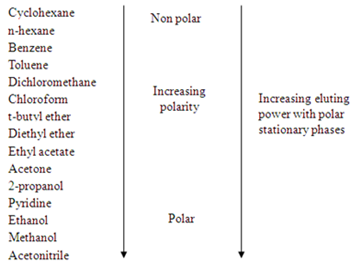
The compounds in the mobile phase will have different interaction with the polar stationary phase. The factors are mainly depends on the polarity of adsorbent (silica gel in this experiment), solvent polarities, and functional groups of the compounds. The polar adsorbent will more strongly attract the polar molecules of compounds and it will have lower affinity to the non-polar compounds. Hence, the movement of compounds with different polarities could be different. In addition, the polarity of solvent is very important to the compound separations, a solvent system may increase in its polarity by changing the composition of the solvent mixture. The more polar the solvent, the faster the compounds can be drawn up, which means the further the compounds move. The comparison of the polarities of solvent are listed down in the diagram 1.
image

Diagram 1

The second factor that affects the interaction between stationary phase and compounds is functional group of each compound. The highly polar groups in compound will cause the stronger adsorption and eluted less readily to the stationary phase compared to less polar compounds. Hence, the highly polar compounds will tend to interact strongly with the polar adsorbents and absorb onto the fine particles of the absorbent, hence it travel slowly. The adsorption strengths of each compound having the following types of functional groups in the order of increasing group polarities.

image

However, the variation may take place which depends on the overall structure of each compound.

In a typical procedure, a mixture of compounds is applied to one end of a plate or column of stationary phase. Then a mobile phase which can carry the compounds in the mixture is allowed to run over or through stationary phase, starting from the end at which the compounds were applied and going to other. As the mobile phase runs, the compounds with strongest bonds to the stationary phase continually displace the others which are then carried further up the chromatography. Consequently, the most weakly bonded molecules end up furthest along the plate and as times goes on, the individual compounds are all separated from each other.

In this experiment, the mixture of the compounds are applied to the bottom of plate or sheet which holding a thin layer of the stationary phase. The mobile phase is allowed to move along the plate by capillary action to develop the chromatography. The compounds are visualized and marked on the plate. In order to visualize the compounds, ordinary visible light is used for coloured compounds, UV light is used for compounds that contain double bonds, and the certain reagent (iodine) is used to react with the separated compounds to produce coloured spots.

Finally, the position of each spot on the plate is measured and reported as the retention factor (or retardation factor), Rf value. Retention factor is the ratio of distance traveled of the compound to the distance of the solvent traveled. Retention factor, Rf is the distance of compound traveled divided by the total distance of solvent travelled in TLC plate. The Rf value are important because they are a consistent property of a compound so long as the stationary and mobile phases are identical. The Rf value can assist in identifying a compound. If two spots travel the same distance on the TLC plate or they have the same retention factor, then both compounds might be concluded as the identical compound.

image

Materials:

Commercial felt tipped writing pen, spinach, sand, chloroform (CH2Cl2), methanol (CH3OH), petroleum spirit, ethanol (CH3CH2OH), 2M ammonia solution, 1-butanol (C8H10OH), acetone

Apparatus:

Capillary tubes, mortar and pestle, Merck TLC plate, Whatman 12.5cm filter paper, Pasteur pipette, ultra-violet light (long wave length and short wave length)

Procedure:

Part I: Separation of inks from a commercial felt tipped writing pen

Prepare the developing tank

1. 6ml of 1-butanol, 2ml of ethanol and 2ml of 2M ammonia solution were prepared into two 150cm3 beakers.

2. A filter paper was inserted into each beaker and the solution was swirled to wet the paper.

3. Each beaker was covered by a watch glass.

Spot the plate

1. 8.5cm x 3cm of chromatography paper (Whatman SG 81) and 10cm x 3.5cm TLC plate were obtained which can fit inside the developing tank without touching the watch glass.

2. For filter paper and TLC plate, two dots with 1cm apart and 1.2cm from the bottom edge were made by pencil. The dots were labeled as “1” and “2”. The sample (marker ink 500) was spotted on the spot marked “1” once and three times on the spot marked “2”.

3. Steps 1 and 2 were repeated by using marker ink 500A and food dye (red).

Develop the chromatogram

1. The chromatography paper and TLC plate were placed into the different developing tank and make sure that the spots are above the solvent level.

2. The beakers were covered with glass watch.

3. The solvent was allowed to travel upwards.

4. The filter paper and TLC plate were removed and the maximum height of the eluent reached was marked with pencil.

Record the result

1. An accurate drawing was made to show the identity of the sample, the type of stationary phase, the mobile phase, the colour of each discernible spot, the method of visualization and the Rf value for each compound.

Part II: Separation of spinach leaf pigments by TLC

Prepare the developing tank

1. 10ml mobile phase was prepared from the mixture of 9.5ml CH2Cl2 and 0.5ml CH3OH.

2. The mixture was poured into a 150cm3 developing tank.

3. A filter paper was inserted and the mobile phase was swirled to wet the filter paper.

4. The beaker was covered by a watch glass.

Extraction procedure

1. 10g of spinach was grinded by using a mortar and pestle with a portion of sand as extra abrading agent.

2. 20ml of acetone was added and the sample was grinding until the extract is green and the spinach is completely pulped.

3. 10ml petroleum spirit was added and it was mixed quickly with the sample by using pestle.

4. A Pasteur pipette was used to transfer 5ml of the liquid part of the mixture into a 10cm3 glass vial.

5. The vial was capped immediately.

Spot the plate

1. A 1.5cm x 6.6cm TLC plate was used and a dot was made by using a pencil from 1.2cm from the bottom.

2. The green layer of spinach was spotted on the plate several times.

Develop the chromatogram

1. The TLC plate was placed into the developing tank.

2. The solvent front was marked.

Record the result

1. The plate was observed under UV light and the observation was recorded.

2. Accurate drawing of TLC obtained was drawn to show the identity of the sample, the type of stationary phase, the mobile phase, the colour of each discernible spot, the method of visualization and the Rf value for each compound.

Results and calculations:

Based on the formula below to calcuate the retention factor of each component in the sample.

image

Rf is refers to the retention factor.

Observation:

image


image

Observation:

image

Material used

Thin layer chromatogram (TLC) plate (10cm x 3cm)

Filter paper (8.5cm x 3cm)

Distance of solvent travelled

-

-

Observation:

image

image

Observation:

image

Material used

Thin layer chromatogram (TLC) plate (10cm x 3cm)

Distance of solvent travelled

8.5cm

Rf value of 1st spot

0.09

Rf value of 2nd spot

0.15

Rf value of 3rd spot

0.31

Rf value of 4th spot

0.49

Number of spot

Rf value

Colour observed

1st spot

0.09

Yellow

2nd spot

0.15

Yellow

3rd spot

0.31

Yellow

4th spot

0.49

Green

Discussion:

In the thin layer chromatography, the eluent (solvent) is prepared by using a mixture of 1-butanol, ethanol and ammonia solution in the ratio of 6:2:2. The polarity of the particular solvent cannot be too low because the polar compounds will not be able to carry by the eluent and will not be separated, so that the separation might not be observable. If the solvent of too high polarity is used, the polar compound will travel so fast that the separation between non-polar compound and polar compound to become so small and poor separation will be observed. The solvent mixture is believed that it has the optimized solubility for the organic compounds to dissolve in the solvent. In another word, the compounds can be easily to be carried by the solvent in the TLC plate and filter paper. Before the plate is placed into the solvent, a filter paper was dipped inside the solvent in a beaker which is covered by an evaporating flask. This is to create a system that full with the vapours of organic solvent and hence the solvent is allowed to travel up along the plate faster. After the plate was introduced into the solvent, the solvent start to migrate itself and the compounds move along with solvent until the solvent front has been reached.

There are three components in the chromatography study in which includes the TLC plate with adsorbent or filter paper, the development solvent and the organic compounds that to be analyzed. The adsorbent, silica gel consists of a three dimensional network of thousands of alternating silicon and oxygen bonds. It is a very polar and is capable of hydrogen bonding due to its partial positive charge in silicon and partial negative in oxygen. The silica gel with compete with the development solvent for the organic compounds as the solvent is traveling up through the TLC plate. The silica gel tends to bind the compounds (on stationary phase) while the development solvent tried to dissolve the compounds (on mobile phase) in order to carry the compounds along the plate as the solvent travels up. All the compounds are possible to be adsorbed into the stationary phase however the time of adsorption of compounds in the particular phase is depends on the polarity of each compound. The more polar the compound is, the longer the time taken that the compound adsorbed into the stationary phase so it eluting speed is slower (more time on stationary phase). Less polar compounds are weakly adsorbed, so the time taken for less polar compounds to be adsorbed on stationary phase is shorter. As a result, the less polar compounds can travel further along the plate compared to the more polar compounds. In the paper chromatography, the organic compounds also tend to move upward and the mobile phase carries the organic compounds to run over or through the stationary phase. However, the paper chromatography might not be suitable for some compounds since the compound separation is not good enough in certain case.

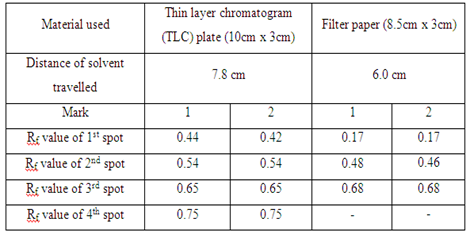
In the first part, the food dye (red colour), marker ink 500, and marker ink 500A were used in the study of the chromatography. In the chromatogram a, the food dye were applied one time and three times separately in two different spots (marked as 1 and 2 respectively). The result obtained showed that the distances of each component in food dye moved are almost identical in the TLC plate. This proved that the number of sample spotted on the plate did not affect the distance of each component in food dye travelled in TLC plate. However, the separation of compound in filter paper was not good. This is because there are only three spots appeared on the filter paper (which is shown in chromatogram b) while TLC plate has four single component. In chromatogram c and chromatogram d, there is no spot being observed in both chromatograms. This might be due to the low polarity of sample ink marker 500 in which the low polar organic compounds cannot move in either TLC plate or filter paper. By comparing the chromatogram e and chromatogram f, both chromatograms have one similarity in which they showed that only one component present in the ink marker 500A. Two spots (one spot is being spotted once and another one spot is being spotted three times) in both chromatograms shows the similar Rf value and hence two compounds can be concluded to they migrated the same distance in each chromatogram.

In the second part of the experiment, the spinach was being applied on a TLC plate. The TLC plate showed there are total four components in spinach. The Rf value of the first spot, second spot, third spot, and forth spot are 0.09, 0.15, 0.31, and 0.49 respectively. The colours of each spot in the TLC plate have been recorded, which the compounds with Rf value of 0.09, 0.15 and 0.31 showed yellow colour while the forth spot showed green colour. The yellow spot are predicted as the xanthophylls while the green spot is predicted as chlorophyll. Xanthophylls and chlorophylls are the pigments that usually can be found in the plant

Safety concerns:

1. Always wear goggles and gloves.

2. Handle and dispose the mobile phase into the waste bottle.

3. Do not shake or disturb the mobile phase after TLC plate has been introduced into the beaker.